
Safenet has strengthened its approach to supporting survivors of domestic abuse by completing workshops with Brainkind, the UK’s largest national charity for people living with brain injuries and neurological conditions.
More than 40 Safenet staff took part across two development sessions as the organisation prepares to introduce Brainkind’s new screening and support tool, Brainkind Adapt, into everyday work. The sessions mark a significant step in helping frontline teams recognise and respond to the often-hidden effects of head injury and non-fatal strangulation, issues that are common in domestic abuse but can easily be missed.
Brainkind Adapt guides staff through conversations that can be difficult but essential, helping them explore symptoms, understand how potential neurological impacts may show up day-to-day, and tailor support plans accordingly. The tool also creates a personalised summary for survivors, which they can choose to share with their GP, helping them access medical support if they want it.
Safenet played an important role in the development of Brainkind Adapt before its national launch. After initial discussions, managers worked with Brainkind’s Brain Injury and Domestic Abuse Researcher, Stephanie Bechelet, who invited the organisation to take part in the pilot. Throughout 2024, staff at Safenet’s Lancaster refuge and Jane’s Place tested the tool with survivors, alongside other pilot partners.
During the pilot, a survivor arrived at Jane’s Place after a serious assault and appeared confused and struggling to communicate. Thanks to the brain injury training staff had already received, they recognised the signs early. When the survivor later began having seizures, she was taken to hospital, where doctors advised she needed to remain under medical care. Using Brainkind Adapt helped staff understand her symptoms more clearly and contributed to identifying an underlying brain injury, allowing support to be shaped with much greater care and awareness.
Following a series of interviews, feedback sessions, and refinements, Brainkind Adapt was officially launched in November 2025 and has been used over 100 times. Safenet has since held additional workshops to make sure staff feel confident using the tool as part of risk assessments, safety planning, and longer-term support.
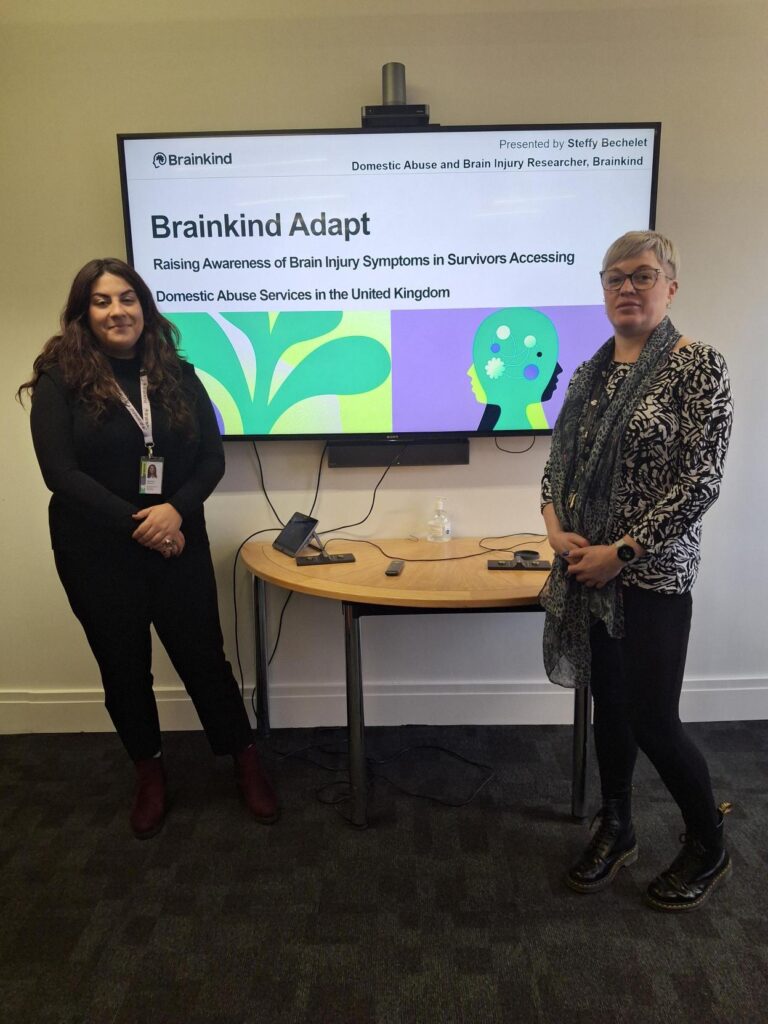
Brainkind Adapt is now being introduced as standard practice for anyone presenting with head trauma or non-fatal strangulation. Non – Fatal strangulation refers to any act that involves applying pressure to the neck, restricting blood or airflow without causing death, and is often seen in domestic abuse cases. Symptoms can be subtle; forgetting appointments, struggling to concentrate, or sudden shifts in behaviour, but these can have a huge impact on a survivor’s wellbeing and their ability to receive support.
For Karen Bailey, Safenet’s Training and Development Officer, the introduction of Brainkind Adapt represents a meaningful step forward.
“We are introducing the tool as part of our assessments to support survivors who have experience with head trauma and non-fatal strangulation,” she explained.
“It’s so important our survivors are getting the right support and we’re assessing risk properly from an early stage. This could be the difference in a survivor’s journey; with this tool, you are able to gain a full holistic view of survivors needs.
“It can have such a positive impact, not only on their recovery from the trauma of abuse, but their lives going forwards.”
Safenet’s involvement in the pilot, combined with its commitment to person led trauma informed support, highlights the organisation’s dedication to improving outcomes for survivors.
By embedding Brainkind Adapt into everyday practice, teams will be better equipped to recognise brain injury, respond to them sensitively, and ensure survivors receive the holistic, informed care they deserve.