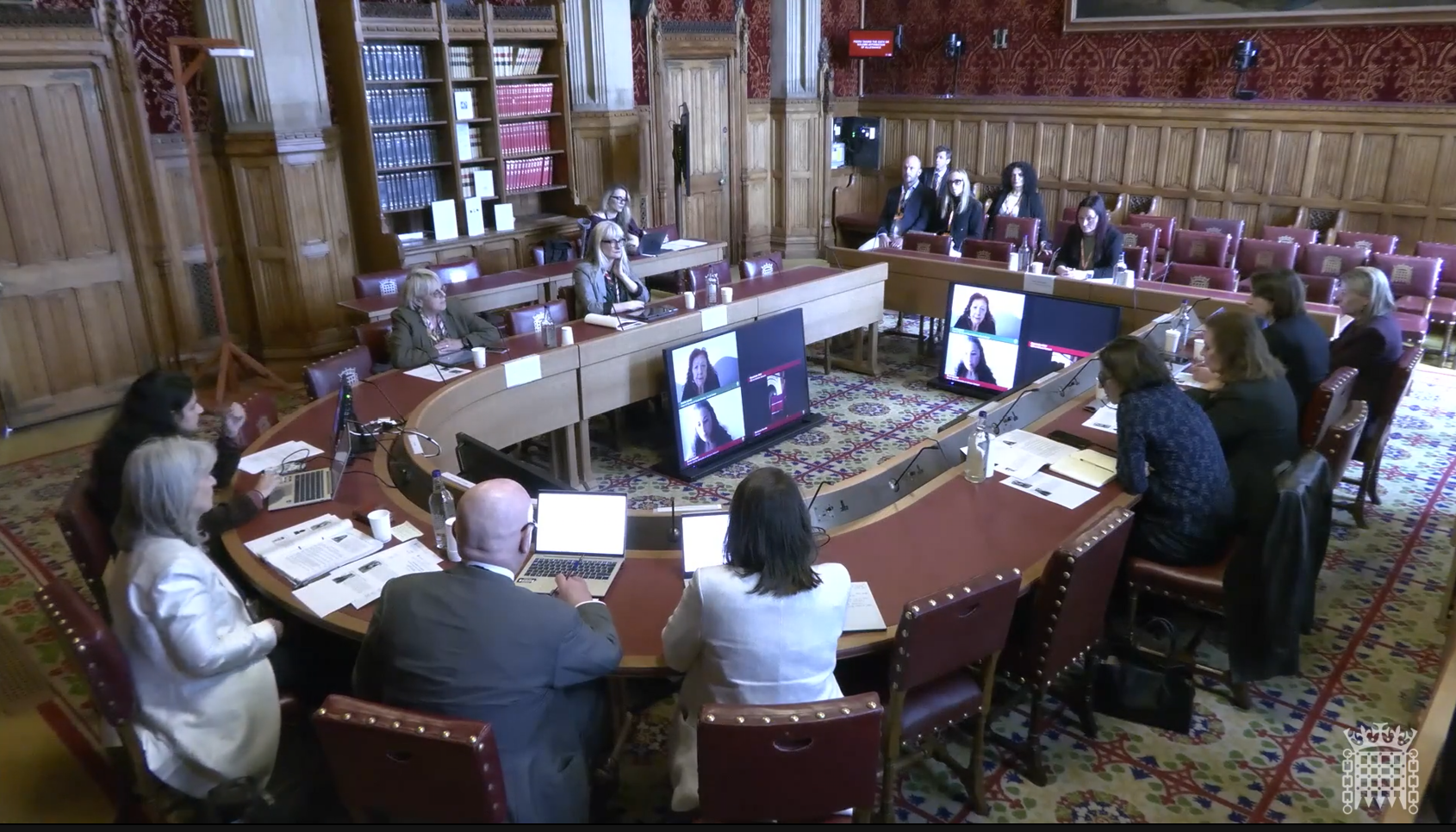
Last Thursday, Alex Atkinson, Director of Operations at Safenet, gave evidence to the House of Lords Domestic Abuse Act 2021 Committee at the Palace of Westminster.
Chaired by Baroness Kennedy of The Shaws, the Committee is carrying out post-legislative scrutiny of the Act, five years on. Its role is simple: to test whether the legislation is working in practice, based on the experiences of organisations delivering support on the ground.
Around the table were peers from across the House of Lords, alongside practitioners from across the domestic abuse sector. Alex joined colleagues from CoLab Women in Exeter and the Ashiana Network, each bringing a different perspective on how the system is operating.
The focus was not on what the Act set out to do. It was on what is happening now.
There has been progress. But the system is still under pressure, still uneven, and still not working consistently for the people who rely on it.
A system that is working better
Some of that progress is visible and the system working is clearer than it was, with better defined access routes meaning survivors are less likely to be passed between services repeating the same story again and again.
Alex reflected on how this had led to practical changes that have opened up clearer pathways for survivors:
“It is really important that no single agency holds the full picture of what is happening for survivors. It has definitely reduced the burden that is placed on survivors to navigate a really difficult system when they are already experiencing really high levels of trauma. We were able to improve the single point of access so that they are not having to repeatedly tell agencies the risk that they are experiencing.”
Statutory agencies now have a better understanding of how to access specialist support. The domestic abuse sector itself is more visible and more clearly understood. In simple terms, the system is more connected.
However, that connection does not always translate into shared responsibility.
But still more to do
Alex was clear about where this breaks down in practice; a gap between planning and follow‑through. Plans are made and information is shared, but ownership of the next step is not always clear:
“It is still not necessarily clear who is going to follow up and follow those actions. The burden is still very much placed on the DA sector to follow up on those actions. We are often continuing to hold that case and hold the risk while trying to hold other agencies to account.”
In practical terms, the same services continue to carry the risk while chasing action elsewhere. The structure has improved, but the distribution of responsibility has not fully caught up.
This gap shows up in how services work together.
The MARAC process remains a central part of the system. The way it functions has shifted and multi-agency working has become more structured, but less impactful at the point where it matters:
“The MARAC process has become about sharing that information. Historically, you had the opportunity with partners around the room to be really creative about the safety options and how to reach survivors to help them to feel safe to engage in services. The burden is still on one or two services to enact the safety element. In terms of getting the outcomes for survivors, that is already done prior to MARAC.”
She is pointing to a system that has strengthened its process, but not always its outcomes. Information is shared more clearly, but the responsibility for turning that into action is still uneven.
What is less consistent is what happens next.
Much of the real work of reducing risk is already happening outside those formal structures, in frontline services responding in the moment.
“As soon as survivors come to our services, we work to reduce the risk to them… we work to reduce the impact to their safety.”
The result is a system where process and response do not always align; the formal system manages risk but the services themselves often carry the responsibility for reducing it.
When cases are most complex, the system can struggle most
The pressure becomes most visible in complex cases. Where there are overlapping risks, long histories, and multiple needs, the system does not always become stronger.
Sometimes it slows down, but as Alex says, it’s not about a lack of effort – it’s about uncertainty:
“Where there are really high levels of complexity, agencies can sometimes respond by almost becoming fatigued, because they do not really know how to reach survivors and support them. If you can get the right people in the room… you could be a lot more creative… and have a really good understanding of why we are there with that survivor and what their story is.”
The system works best when it understands the person, not just the case.
Children: recognised, but not fully supported
One of the clearest areas of progress is the recognition of children. There is more funding, and more focus, enabling more consistent support, but there are still gaps:
“Supporting children has often been the least stable part of the domestic abuse sector historically [but now] the recognition of children in their own right has definitely improved the response from agencies. [However] there are still missing elements of that more therapeutic support around the impact that children experience.”
Support does not always extend far enough into recovery.
The burden still sits too heavily with survivors
Running through all of this is a more fundamental issue: where responsibility sits – and, as Alex said, this shapes how the system operates in practice:
“Survivors are placed with the responsibility to keep themselves safe; the focus is not placed on the perpetrators’ behaviour. We are asking a survivor to leave your house, leave your family, leave your community… with no action taken against the person who is perpetrating the violence. That makes it really difficult to build the trust of survivors… when they feel that you are watching what they are doing.”
Services are designed to safeguard. But they do not always feel that way to the people using them.
Capacity and movement remain key pressures
Alongside how the system works is a more basic constraint: capacity. Alex highlighted how demand, sadly, still greatly outstrips supply, and even when someone is in safe accommodation, the next step is not always available:
“We are able to accommodate only around 27% of the referrals that come into our services. [And in some cases] survivors can stay in refuge for in excess of 12 months.”
Safety is achieved, but without appropriate move-on options, recovery is slowed, and services remain under pressure.
Why it matters
The past five years have brought real change: the system is more connected, clearer and more consistent at the point of access. That progress is real. But from a Safenet perspective, the picture remains uneven; accountability is not always clear, complex cases expose gaps, trust can be hard to build, and recovery beyond crisis is too often limited by capacity.
This is the test: not whether the system works on paper, but whether it works when someone asks for help. Whether survivors can reach support without repeating their story, move forward rather than just stay safe, and feel believed and protected.
Safenet is supporting more people than ever, and that matters. Alex’s evidence brought those realities into the room, ensuring survivors’ experiences were heard where decisions are made.